
Searching Burt County Criminal Dockets
Most people start with the Nebraska JUSTICE One-Time Court Case Search. Enter a party name first. A witness name is the wrong starting field. Narrow the results to Burt and the right court level once the facts support it. Treat whatever comes back as a lead toward the court record, not as a finding about any person or outcome.
The live service posts its own limits. A search costs $17, returns at most 30 cases, and keeps results live for a three-calendar-day window. Newly filed information can lag by 24 hours. A no-result search still gets charged. Subscribers use a separate recurring product. If a matter may have moved after a preliminary hearing, check both Burt County Court and Burt District Court, because one empty result settles nothing.
- Start with the notice, citation, complaint, or known case number, then identify the likely court stage.
- Search the name in JUSTICE and apply the Burt court selector only when it helps separate similar results.
- Open the matching Case Detail and compare the case number, court, case type, and status with the information already known.
- Read the Register of Actions for the sequence of filings, settings, orders, and any later disposition entry.
- Contact the responsible clerk for a plain or certified record when a portal result does not answer the document question.
A brand-new filing or a recently reset hearing can take time to appear in the system. Until it does, the clerk-confirmed entry controls.
Burt Criminal Docket Layers in JUSTICE
JUSTICE splits one Burt criminal case into several views. Each layer answers a different question. Case Detail can list the judge, the trial date, the subject, and outcome fields. Party Listing names the defendant and the prosecuting party, plus attorneys when entered. Court Cost Information and Payments track the money side. The Register of Actions gives the docket itself, entry by entry in order. Some filings link to an image, but a docket line is never the document itself.
The public-access rules add more electronic categories: party indexes, summaries, calendars, and judgment or order summaries. A calendar entry shows a scheduled time and place. It does not prove what happened at the hearing. For the action that followed, read the later Register entry, a signed order, or the clerk-confirmed record.
Criminal cases that reach a higher court show up in the official criminal appellate call sample. That page lists the labels used on appeal: case number, call date and time, originating court and county, location, court type, case summary, proceedings below, issues, and schedule code. Those are field categories only. It shows format, not outcomes.
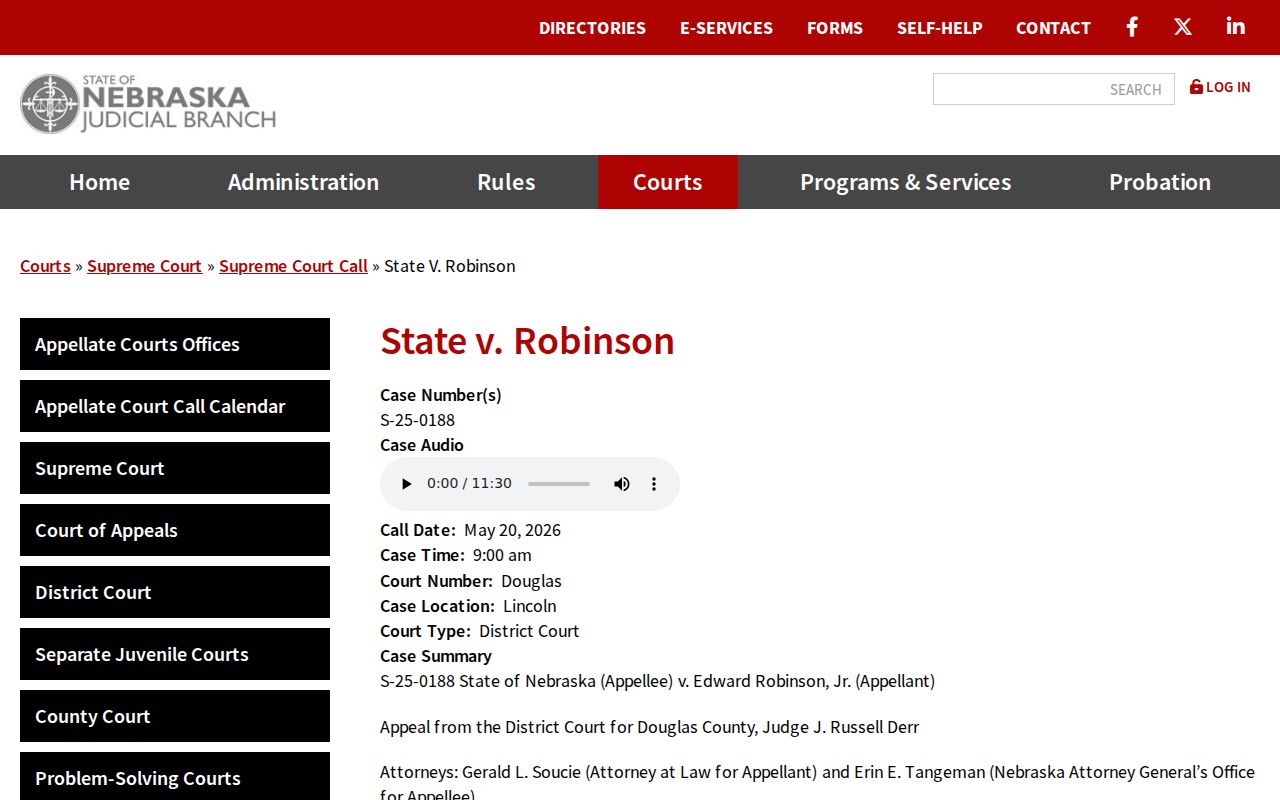
One more layer exists. An appellate call can confirm a Burt origin and a setting, but it never replaces the County Court or District Court Register of Actions.
Inside a Burt County Criminal Docket
Most Burt County criminal dockets open with an electronic case number and a case header. The header ties together the court, caption, case type, judge, and dates. Party roles come next. Below them runs the Register of Actions. Exact shorthand varies by live record. Ask the court about an unfamiliar label instead of guessing at its meaning.
| Case ID | A court indicator and type may appear in the number. Dxx CR-YYYY-###### illustrates a district criminal pattern only; read the actual Burt number rather than guessing its county code. |
|---|---|
| Case Detail | Header information, subject, judge, and trial or outcome dates when available. |
| Register of Actions | Chronological entries such as complaint, plea, hearing, motion, order, judgment, disposition, or appeal. |
| Calendar fields | Date, time, location, and caption for a scheduled proceeding. A later docket entry can supersede that setting. |
| Images and costs | Document images may be linked when available; costs, fines, restitution, judgments, and payments are separate fields. |
Charge lines are not police reports. They are not evidence files either. For the material underneath a charge, ask the clerk or follow the proper discovery process rather than reading the caption as the whole file.
Burt Criminal Courts by Case Stage
Misdemeanors, traffic tickets, and municipal-ordinance violations begin in Burt County Court. Felony preliminary hearings start there too. After bind-over, the felony docket shifts to Burt District Court, which can impose sentences over one year. One flat local database does not hold it all.
| Likely Burt docket | Typical criminal work | Next check when needed |
|---|---|---|
| County Court | Misdemeanor, traffic, ordinance, and preliminary felony proceedings | County Court record and calendar |
| District Court | Felony proceedings after bind-over, sentencing, and related district records | District Clerk Register of Actions or file |
| Appellate court | Appeal from the trial court under a new appellate number | Public appellate call or document record |
A preliminary hearing is not the felony trial. County Court records often stop right there. When they do, take the known court or case information to the District Court side of the search. A missing document image does not mean the matter was sealed or never existed.
How a Criminal Case Moves
A Burt County criminal docket usually follows the court process in order. Labels vary. So check the latest entry. After each setting, a continuance, plea, dismissal, judgment, or sentencing entry can change what an earlier calendar line meant. Read the docket from the initiating filing through the last recorded action. That chronology is the whole point.
Docket flow: Filing → Arraignment → Pretrial → Plea or Trial → Disposition → Sentencing
A payment line is not a full disposition. The payment system records money. The case record and any signed order still say what the court actually decided.
Never assume a payment ends the court's action. The state's own payment warning says a warrant stays active until it is recalled. For an active warrant or an urgent appearance question, confirm the current status with the responsible Burt court.
Burt Criminal Case IDs and Court Split
In Nebraska's published case-code examples, CR marks a criminal case. That first court indicator splits County Court from District Court. Read the exact Burt identifier off the live file itself. A citation number is different again. The uniform-citation rule allows up to two letters followed by seven numerals. It permits no leading zero.
- Arraignment
- An appearance at which the charge and the next procedure are addressed.
- Preliminary hearing
- A County Court felony-stage hearing that can result in bind-over to District Court.
- Disposition
- The outcome or status recorded by the court, such as dismissal, plea result, judgment, sentence, or appeal.
These are plain descriptions only. Burt County publishes no local code key that maps every criminal entry to a fixed meaning.
Courts That Hold Criminal Dockets
Misdemeanor, traffic, ordinance, and preliminary-felony dockets in Burt County live with County Court. That office belongs to Clerk Magistrate Vicki Kuhlmann. The official County Court card lists the office at 111 North 13th Street, Suite 9, Tekamah, with telephone 402-374-2950 and hours of 8:00 a.m. to 4:30 p.m. Monday through Friday. Call before you go. A District Court criminal file is a different office entirely. Michele R. Quick, Clerk of the District Court, works out of Suite 11 at the same address. Her telephone is 402-374-2905.
Burt District Court Clerk
111 North 13th Street, Suite 11
Tekamah, Nebraska 68061
402-374-2905
District felony records, docket questions, copies, and certification.
The District Clerk keeps a public terminal for searches but does not run the search for you. Published District Court copy fees are $0.25 per page and $1 per document certification. Call the County Court first to confirm its packet, mailing, and turnaround details before sending any payment.
Burt Criminal Docket Image Access
Rule §2-215 opens trial and appellate filings to the public. A law, rule, or order can still restrict them. The same rule allows inspection at the trial-clerk public terminal, the appellate-clerk terminal, or the Nebraska State Library terminal. What it cannot do is turn an unscanned paper file into a remotely viewable image. JUSTICE notes that some filings after April 16, 2008 may carry images. Those remain subject to conversion and restrictions.
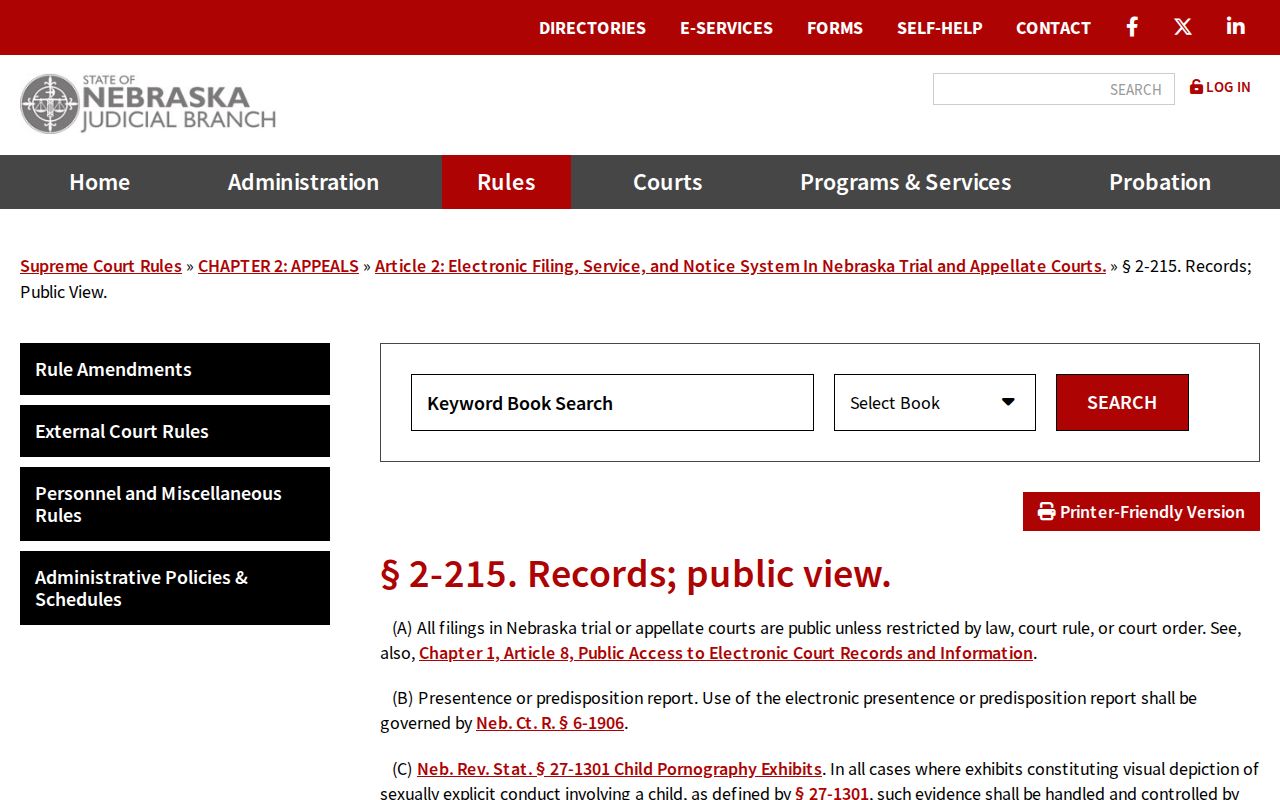
A remote docket result sometimes has no image. The public-terminal rule gives you a practical fallback then. It is not permission to reproduce restricted material or private identifiers. Nebraska Judicial Branch eFiling handles attorney eFiling, eService, and eNotice. That system is separate from public case lookup. A non-attorney should not assume it is required for every filing option.
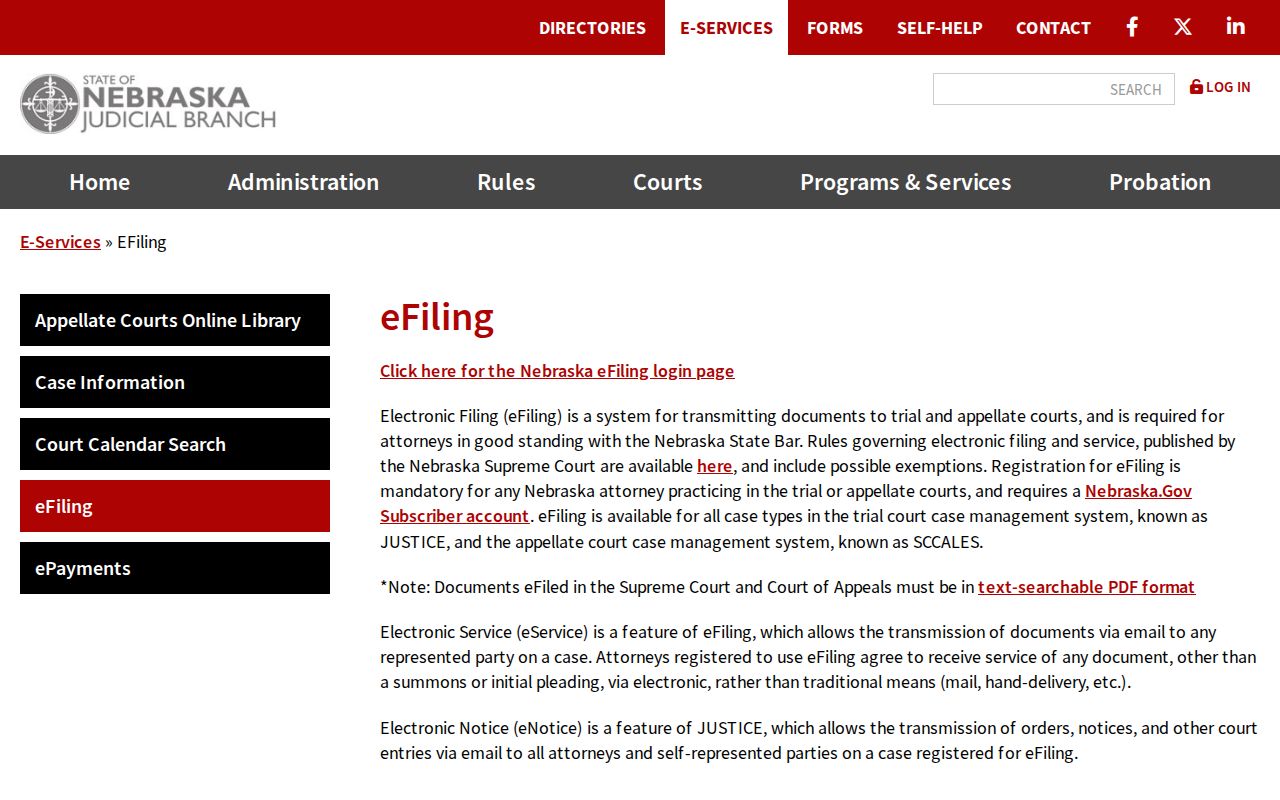
Non-attorneys can file with the court in person, by mail, or by qualifying fax. Email filings are not allowed for court cases.
Sealed Dockets and Public Access
Nebraska's public-access rules open party indexes, case summaries, Registers of Actions, calendars, and judgment or order summaries. Access may still be restricted in a given case. A visible case line does not guarantee that its linked document is public. Juvenile records carry separate statutory limits. Burt County Court also serves as the juvenile court here. A juvenile adjudication is not a conviction.
Access rules: Rule §1-805 identifies the public electronic categories, including Registers of Actions with images when available. Rule §1-809 addresses courthouse-terminal and remote availability. Neb. Rev. Stat. §43-2,108 governs juvenile-record confidentiality and exceptions.
Note: A failed image link can reflect restriction, conversion, or document type. Ask the responsible clerk before drawing a conclusion.
Burt Criminal Docket Search Follow-Up
A missing case has two common explanations. New filings can sit inside the service's 24-hour lag. Or a preliminary felony matter may have moved from County Court to District Court. Check both. Then try the courthouse terminal or call the correct suite. For a formal record, ask for the specific Register of Actions, order, judgment, or certified copy. Do not settle for a blanket search result. Clerks do not issue a certificate stating that a search turned up nothing.
A set-aside petition works differently from unsealing a record. The sentencing-court route under Neb. Rev. Stat. §29-2264 rests on its own authority. The sealed-record procedure rests on different authority and paperwork. For help locating a current case, use the Burt County Case Lookup.